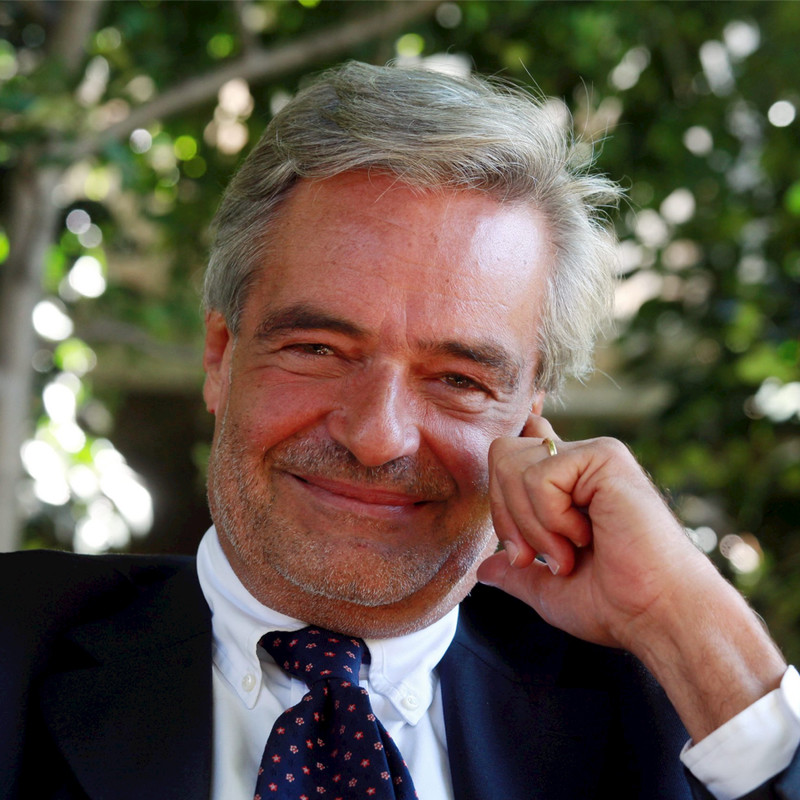
From international journalism to the world’s largest exhibitions, Paolo Glisenti has spent his career exploring one essential idea: communication brings people together. Now, through Querlo’s Digital Twin technology, his experience and perspectives can become part of an ongoing conversation.
A Career Built on Curiosity
Few professional journeys follow a perfectly straight line. Paolo Glisenti’s certainly hasn’t.
His career has taken him through journalism, international finance, corporate communications, television and film production, and some of the world’s most ambitious international exhibitions.
What connects these seemingly different experiences is a lifelong interest in communication and the relationships it creates.
In a recent conversation with Querlo, Glisenti reflected on the unexpected turns of his professional life. Rather than following a rigid career plan, he embraced opportunities that allowed him to meet new people, explore unfamiliar environments, and develop new skills.
He began his career in journalism, working with ANSA, the Italian news agency, before becoming a correspondent in London. His professional journey subsequently included Il Sole 24 Ore and Corriere della Sera.
A move to New York brought him into corporate communications and investor relations at Montedison, the major Italian industrial group. He later returned to Italy and expanded his experience into television and film production.
Despite these changes, one principle remained constant: the importance of understanding people and communicating across different environments.
From Journalism to the World Stage
Glisenti’s international career eventually led him to World Expos — events where governments, businesses, institutions, and millions of visitors come together to exchange ideas and imagine the future.
He held a senior position in Milan’s successful bid to host Expo 2015, helping establish the city on the international exhibition stage.
In 2018, he was appointed Commissioner General for Italy’s participation in Expo 2020 Dubai, a landmark exhibition held in the United Arab Emirates from October 2021 to March 2022.
The Italian Pavilion presented the country’s strengths in creativity, scientific research, technology, culture, and collaboration.
For Glisenti, these exhibitions are much more than large public gatherings. They are platforms for international dialogue, connecting countries and communities that might otherwise have limited opportunities to work together.
He was also appointed Italy’s Commissioner General for Expo Osaka 2025 in 2022, before the role passed to Mario Vattani in 2023.
Today, Glisenti continues to work as an independent advisor on global events, communication, and international cooperation.
Why the Future of Global Events Is About Connection
One of the most interesting ideas from our conversation was Glisenti’s observation that international events are changing in fundamental ways.
World Expos were traditionally strongly associated with the countries hosting them. Today, their influence reaches far beyond national representation.
Cities, regional communities, universities, cultural institutions, and businesses are increasingly becoming active participants in their own right.
This is also a theme Glisenti explored in his April 2026 commentary for the Italian Institute for International Political Studies (ISPI), where he examined how cities compete to host international events and attract investment, talent, and innovation.
In his view, competition between cities can also create opportunities for cooperation.
An international exhibition can establish partnerships that continue long after its doors close. Its legacy may include new infrastructure and investment, but also relationships, shared knowledge, and cultural understanding.
And as major events become more international and multidisciplinary, communication becomes even more important.
Artificial Intelligence, Robotics, and the Next Generation of Events
Technology was another central topic of our conversation.
Glisenti sees artificial intelligence as a valuable tool for improving the planning and management of international exhibitions.
AI could help connect participants across countries, simplify operations, reduce organizational costs, and support the long-term sustainability of major events.
He is also interested in the practical role that robotics could play in the events industry.
From welcoming visitors and providing information to supporting security, hospitality, and crowd management, robots could become increasingly visible at major exhibitions.
For Glisenti, their significance goes beyond operational efficiency.
They could also become a way for host countries to demonstrate innovation, introduce emerging technologies to the public, and create new forms of interaction between visitors and event environments.
Looking ahead to Expo Riyadh 2030, he sees considerable potential for technology to contribute to an exhibition that connects cultures, industries, and regions.
These are not simply questions about machines replacing existing services. They are questions about how technology can help large, complex environments become more accessible and connected.
The Human Perspective Behind Every Innovation
Despite his enthusiasm for emerging technologies, Glisenti consistently returns to the importance of people.
Inclusivity is one of the defining principles of his professional philosophy.
He believes that working across cultures, countries, and disciplines creates opportunities that cannot emerge from isolated thinking.
His advice to younger professionals reflects the same outlook: remain curious, embrace uncertainty, and avoid limiting yourself to a single professional identity.
He also believes that strong leadership requires clear direction. In large international projects involving many different stakeholders, everyone must understand the common objective.
These ideas offer a reminder that technological innovation is most meaningful when it supports human ambitions rather than becoming an end in itself.
Bringing Professional Experience into a New Kind of Conversation
This is where Querlo’s approach to Digital Twins becomes particularly relevant.
A professional career can generate decades of experience, insights, decisions, and stories. Yet much of that knowledge traditionally remains scattered across interviews, publications, presentations, and personal conversations.
A Digital Twin offers another way to make that knowledge accessible.
Through Querlo’s conversational AI technology, a person’s documented experiences, professional perspectives, and communication style can be organized into an interactive knowledge base.
Rather than simply reading a biography, visitors can explore ideas through questions.
What makes an international exhibition successful? How is cultural diplomacy changing? What role might artificial intelligence play in future events? What can young professionals learn from decades of international experience?
These are the kinds of conversations that Paolo Glisenti’s Digital Twin is being designed to support.
The goal is not to replace the individual behind the experience. It is to create an additional way for people to engage with the knowledge and perspectives that person has developed.
A Career That Continues to Evolve
There is something particularly fitting about bringing Paolo Glisenti’s experience into the world of conversational AI.
For someone whose career has been defined by communication — from newspapers and corporate boardrooms to international exhibitions — a Digital Twin represents another evolution in how knowledge can be shared.
His journey also illustrates an important idea: innovation does not always require leaving the past behind.
Sometimes, it means finding a new way to make accumulated experience relevant to the future.
At Querlo, we believe that technology becomes most valuable when it empowers human knowledge, strengthens communication, and creates opportunities for meaningful interaction.
Paolo Glisenti’s story is a compelling example of why that matters.
To explore how Querlo is bringing these ideas into practice, discover our Querlo Events 2026 presentation, showcasing how AI, Digital Twins, and robotics can support international events before, during, and after they take place.
Learn more about how Querlo Digital Twins turn professional knowledge and experience into interactive conversations at querlo.com.