Artificial intelligence is changing the way we teach and learn
By Francesco D’Anna
For more than thirty years, I have taught Mathematics and Physics, and throughout my career I have
seen education change profoundly. Computers, the Internet, interactive whiteboards, digital
platforms and, more recently, artificial intelligence have all become part of the educational
environment.
Every technology has changed the way teachers work. Artificial intelligence, however, is different:
it is not simply a tool we use. It is a technology we can interact with.
A student can ask for a different explanation, a simpler example, an additional exercise, or an
alternative way to approach a problem. For the first time, technology can adapt its response to the
question and, at least to some extent, to the level of the person asking it.
But having an answer does not necessarily mean learning.
This is particularly evident in Mathematics and Physics. When a student solves a problem, I am not
interested only in knowing whether the final answer is correct. I want to know why the student
chose that particular procedure, what steps were followed, and what difficulties were encountered.
The reasoning process is often more important than the final answer.
Artificial intelligence can solve a problem in a matter of seconds. Schools must therefore teach
something even more important: how to understand, verify, and question the answer AI
provides.
This is where the role of the teacher also begins to change.
I do not believe the future of education will be one in which artificial intelligence replaces teachers.
A teacher does not simply transmit information. A teacher observes students, recognizes
difficulties, changes strategies when an explanation is not working, motivates, encourages, and
builds relationships.
AI can instead become a tool that expands these possibilities.
It can provide personalized exercises, alternative explanations, and support beyond school hours. It
can help students with different levels of preparation follow learning paths that are better suited to
their individual needs.
But it can do something even more interesting: extend the teacher’s presence beyond the
classroom.
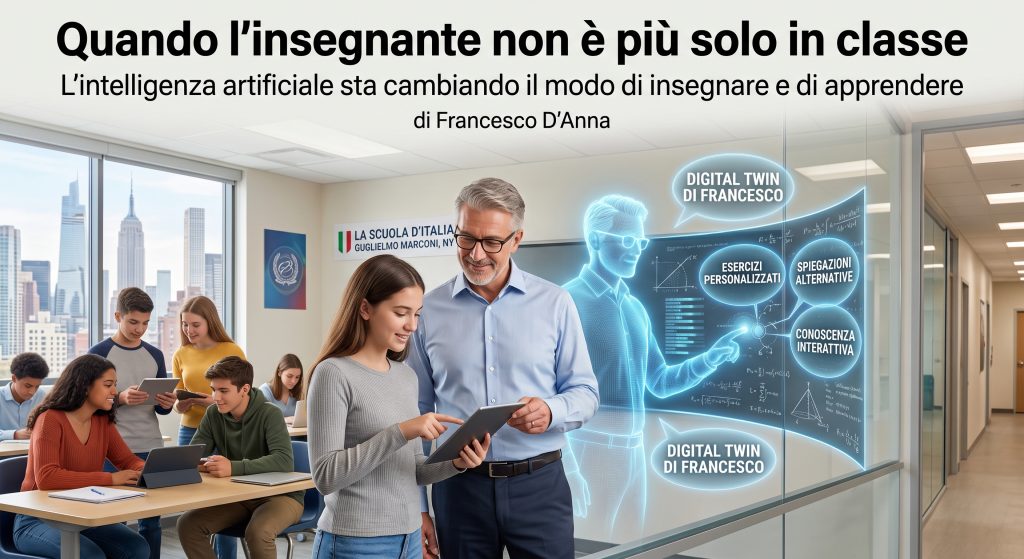
It is from this perspective that I find Querlo’s concept of the Digital Twin particularly interesting.
An AI-based personal avatar can represent a person’s knowledge, experience, communication style,
and content, transforming them into an interactive digital presence.
Imagine a teacher who, after many years of experience, has accumulated hundreds of explanations,
examples, exercises, and teaching strategies. Normally, much of this knowledge remains part of the
teacher’s personal experience and is shared only during lessons.
A Digital Twin could help make some of this experience accessible even when the teacher is not
physically present.
A student could ask for clarification after school, review a topic, or engage with an explanation
developed according to the approach of their teacher.
It would not be the teacher. And it should not be.
Rather, it would be a digital extension of the teacher’s knowledge and experience.
This perspective also changes the way we think about the digital presence of professionals. A
website tells people who we are. A résumé describes what we have done. A Digital Twin, instead,
can allow people to interact with a digital representation of our knowledge.
For education, this possibility is particularly interesting.
The challenge of the future will therefore not simply be to teach students how to use artificial
intelligence. It will be to teach them how to think with AI without giving up their ability to
think independently.
Technology can make knowledge more accessible, personalized, and interactive.
But the mission of education remains what it has always been: to develop people who are capable of
understanding, reasoning, making choices, and creating.
Perhaps the future of education will not be a school without teachers.
It will be a school in which teachers have new tools that allow them to remain present, even
when they are not physically in the classroom.
Bio
Francesco D’Anna is a Mathematics and Physics educator with 33 years of experience in science
education. Appointed by the Italian Ministry of Foreign Affairs and International Cooperation
(MAECI), he currently teaches Mathematics and Physics at La Scuola d’Italia Guglielmo Marconi
in New York, where he also serves as STEM Department Coordinator and Assistant Head of
School. Check out the website: https://www.francescodanna.com/