Technology continues to evolve at an extraordinary pace, bringing new possibilities to industries ranging from entertainment and education to engineering and international events.
Recent developments in artificial intelligence and robotics highlight how quickly innovation is moving from research into real-world applications.
Three developments have particularly caught our attention: Google’s Genie 4, European Robotics Week 2026, and Gemini 4 Carbon.
Google Genie 4: A New Era of Interactive Virtual Worlds
Google DeepMind’s Genie 4 represents another step forward in AI-generated interactive environments.
The technology allows users to create and explore virtual worlds using artificial intelligence, making digital experiences more dynamic and responsive.
Rather than simply viewing a static digital environment, users can interact with simulated spaces and explore new possibilities for creativity, education, and entertainment.
The November 2026 expansion of Genie 4 through Project Genie and developer tools brings these capabilities closer to practical applications.
For the international events industry, this technology opens up interesting possibilities.
Imagine event organizers being able to prototype exhibition spaces, experiment with interactive visitor experiences, or explore virtual environments before investing in physical infrastructure.
While these applications are still developing, AI-generated worlds could eventually change how events are designed, presented, and experienced.
European Robotics Week: Bringing Robotics into Everyday Life
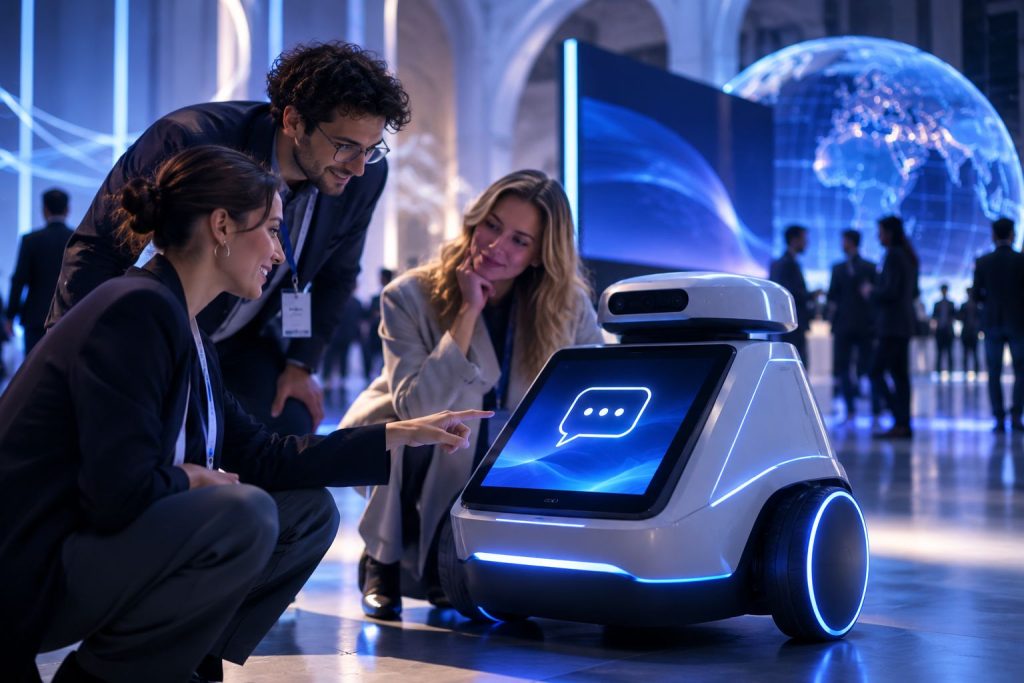
European Robotics Week 2026 brings attention to the growing role of robotics in education, workplaces, and society.
Through events, demonstrations, and educational activities, the initiative encourages people to explore how robotics can contribute to different industries and everyday activities.
The development of robotics is no longer limited to manufacturing and industrial automation.
Robots are increasingly being explored for applications involving customer assistance, logistics, education, healthcare, and public services.
This evolution is particularly relevant to international events.
Large exhibitions, conferences, and global gatherings require complex operational coordination, from visitor guidance and information services to logistics and accessibility.
In the future, robotics could support event teams by assisting visitors, providing information, and improving the efficiency of certain operational activities.
Combining robotics with conversational AI could also make these interactions more natural, multilingual, and accessible.
Gemini 4 Carbon: Advancing AI for Complex Engineering and Cybersecurity
Another important development comes from Google with Gemini 4 Carbon, an advanced AI model designed to handle complex, long-running tasks.
The model introduces stronger capabilities in areas such as software engineering, scientific reasoning, and cybersecurity.
These developments demonstrate how AI is moving beyond answering simple questions toward supporting increasingly sophisticated technical work.
For organizations managing large-scale projects, such capabilities could contribute to more efficient development processes, better technical analysis, and stronger cybersecurity practices.
International events are particularly interesting in this context.
Major events rely on interconnected digital platforms, registration systems, operational infrastructure, and communication tools.
As these systems become more sophisticated, ensuring their reliability and security becomes increasingly important.
Advanced AI models could become valuable tools for supporting the development and protection of these digital environments.
What Does This Mean for the Future of Events?
Although these three developments focus on different areas, they share a common direction: making technology more interactive, intelligent, and integrated into everyday experiences.
AI-generated environments could transform how events are designed and experienced.
Robotics could support physical operations and visitor interactions.
Advanced AI models could improve the technical systems that make large-scale events possible.
Together, these technologies point toward a future where physical and digital experiences become increasingly connected.
At Querlo, we are particularly interested in how conversational AI can help organizations create more accessible and engaging interactions.
Through multilingual digital assistants, interactive experiences, and AI-powered communication, Querlo supports organizations seeking to connect with audiences across different languages and environments.
As technology continues to advance, the opportunities for creating more intelligent and connected event experiences will only expand.
Which of these developments could have the greatest impact on the future of international events?
We would be interested to hear the perspective of Paolo Glisenti, whose experience in global events offers valuable insight into the industry’s evolution.
Discover more about Querlo’s conversational AI solutions:
